Our wishes to you

As we end 2022, we thought that a look back to a warmer, greener, and sunnier time would be a break from the current cold temperatures and barren landscapes.

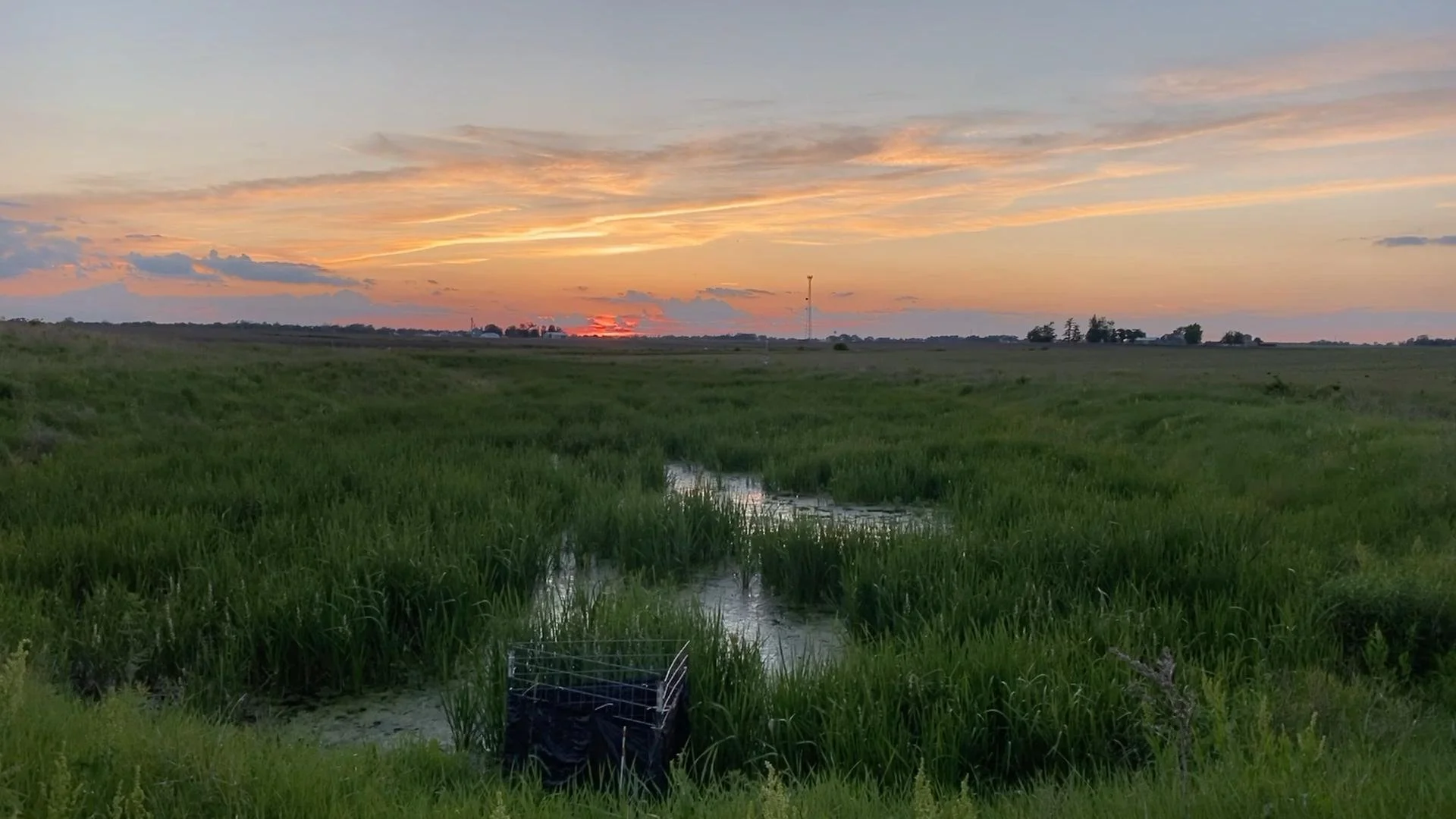
This link will take you to a time lapse of the sun setting over Bureau County Wetland #2 near Princeton, IL

The Smart Wetland team wishes you good health, peace, and joy through the holiday season and in 2023.


How Illinois cropland is feeding the Gulf of Mexico Hypoxic Zone

Without enough nitrogen, plants cannot survive or thrive. In the Upper Midwest of the United States, nitrogen management is one of the most important decisions a farmer makes each crop season. But like many things, too much is not a good thing. This is especially true when excess nitrogen flows into downstream water bodies. This overabundance of nutrients (called eutrophication) creates low-oxygen or hypoxic zones like the one that forms in the Gulf of Mexico every year at the mouth of the Mississippi River.

This Gulf of Mexico “dead zone” is why the Illinois Nutrient Loss Reduction Strategy was created, at the behest of the U.S. Environmental Protection Agency (EPA).  The primary source of the extra nitrogen feeding into the Mississippi River is row-crop production in the Upper Mississippi River Basin.

In the first few thousand years of farming, nutrients were primarily introduced into the ground from the previous crop’s excess plant material or from the waste of humans and/or animals that were living where the crop was produced. As urbanization increased globally in the mid-19th century, more of the crop was sold to feed people in ever-growing cities. A deficit started to develop on the cropland since some of the nutrients in the food were now flowing into urban sewer systems, making it necessary to add fertilizer to farm fields to maintain productivity.

Nitrogen management changed even more in the mid-to late 20th century when greater agricultural mechanization, increasing global demand for food, and technology created relatively cheap artificial fertilizers. However, two other factors supported the increased movement of nitrogen off cropland.

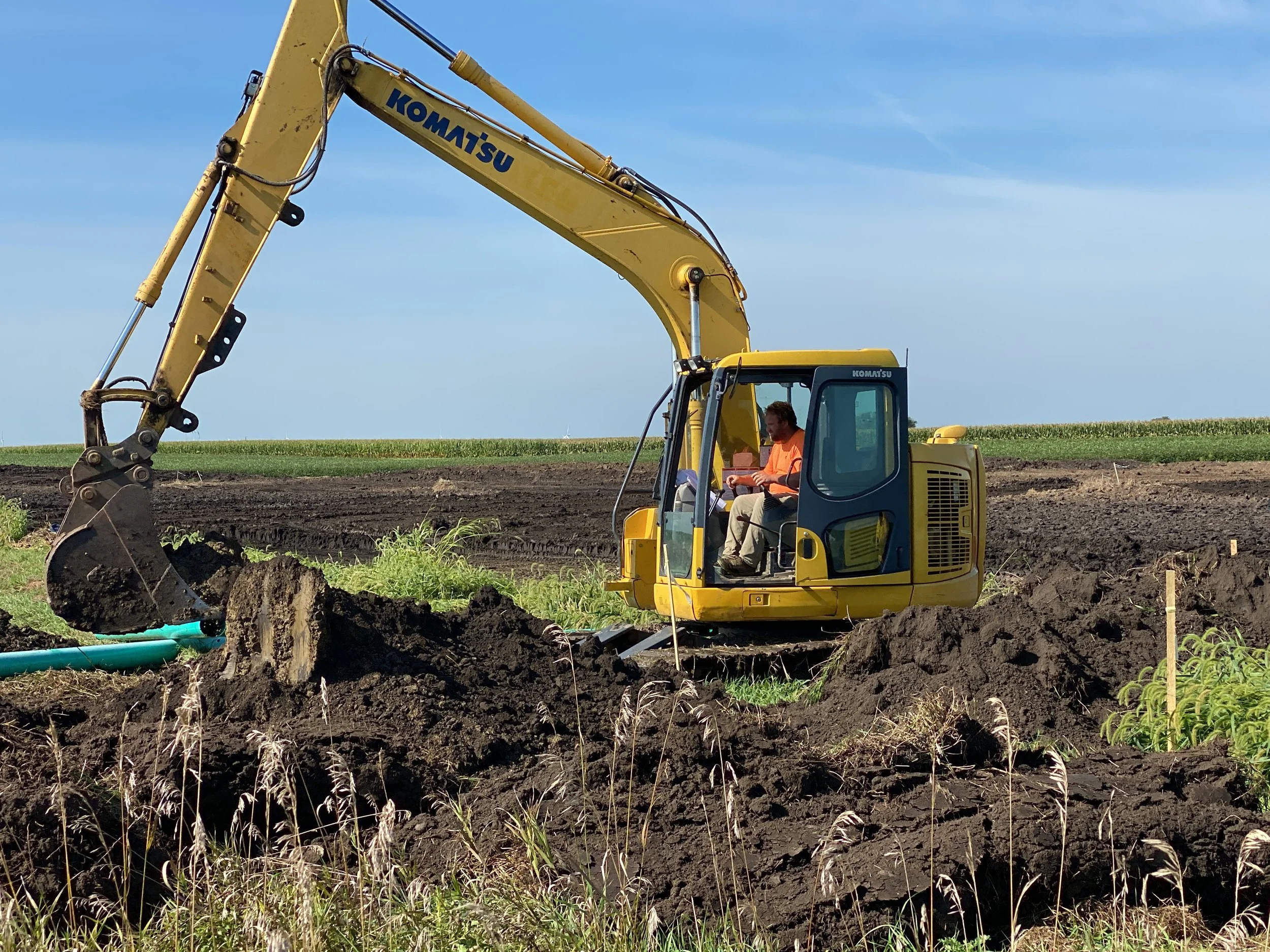
Agricultural drain tile being installed on a farm in Marshall County in September 2021.

First, large, refrigerated ocean-going vessels allow the export of significant quantities of plant and animal products from the U.S. to other countries. The other is the use of agricultural tile drainage. A tile drainage system uses pipes (clay or flexible perforated plastic) buried under cropland to rapidly remove excess water from the soil to increase crop production. These pipes carry the excess water to nearby creeks and rivers. The naturally occurring nitrogen in the soil and the artificial nitrogen added by the farmer each year moves through the soil and into the water drained from the field.

Thus, the excess nitrogen from Illinois cropland flows into Illinois waterways and then to the Mississippi River contributing to the formation of a dead zone each year.

This nitrogen runoff is unintended. Illinois farmers (and their peers in other states in the Upper Mississippi River Basin) didn’t set out to pollute local creeks and rivers with excess nitrogen. However, they must be part of the solution to the problem, and they are using various methods to reduce the amount of nitrogen leaving their fields.

Some landowners are trying to reduce nitrogen loss from their land by retiring row-crop acres that require large amounts of nitrogen to produce even a small crop. Others are changing how much nitrogen they apply and when they apply it. More are growing cover crops to hold nitrogen in the field during the off-season or using products to reduce the likelihood that the nitrogen applied leaves the field.

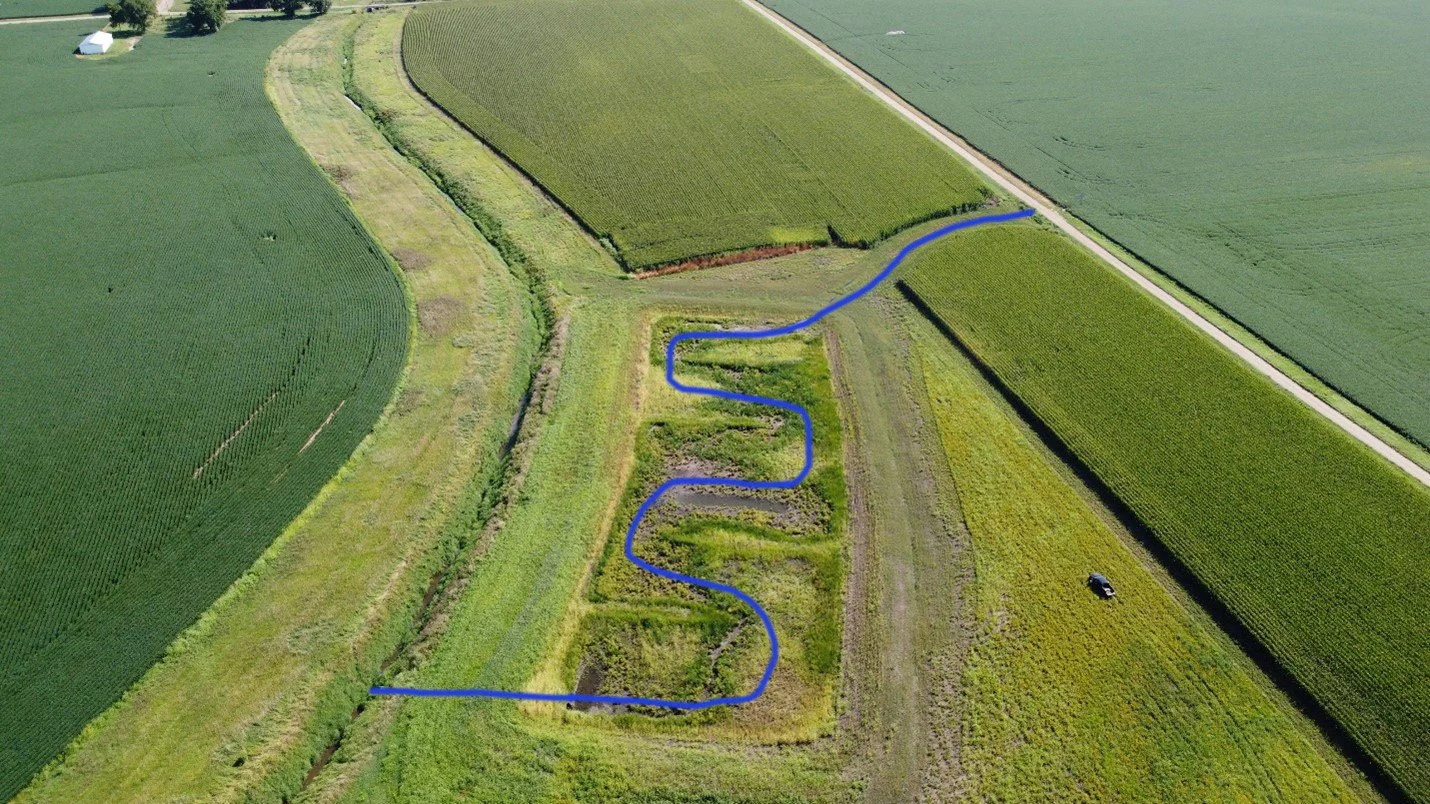
This Smart Wetland was built to intercept agricultural tile drainage water from the field to the right of the gravel road. As the blue line indicates, the water from the tile enters the wetland at the upper right and meanders through the wetland. As it moves through the wetland, naturally occurring processes break down the nitrogen into a harmless gas. The water leaves the wetland at the lower left and flows into the nearby creek with less nitrogen than it carried from the nearby field.

In addition, there are farmers who are using what are known as edge-of-field practices (photo of wetland). These conservation practices feature different types of structures that are built to slow down ag tile drainage water and move it slowly through wood chips (bioreactors), soil (saturated buffers), or water and plants (constructed wetlands) to remove excess nitrogen before it flows into a stream or creek. As you might imagine, we are big supporters of the constructed wetland concept called Smart Wetlands

A Smart Wetland may be right for your Illinois cropland. If you farm or own farmland that is tile-drained or has a tile drainage system running through it and would like to have our team evaluate your property, please complete this form, and we will be in touch.

Jean McGuire is the Field Outreach Specialist for our program and the face of TWI in the counties where we work. She works with our partners to identify landowners who may have an interest in building a Smart Wetland on their property. She and her siblings co-owns the farm she grew up on.

The Mississippi River Network provided support for developing this blog. Consider becoming a River Citizen to help “clean up and protect our country's greatest River.”

Smart Wetlands Put Down Roots

As we established in a previous blog, a Smart Wetland needs to have a healthy, diverse native wetland plant community. The designed water depths are perfect for emergent marsh vegetation. Emergent plants are rooted in the soil, but their leaves and stems stick out of the water. Plant species have different water depth preferences, ranging from saturated soils to 4 feet of water. There are three ways of establishing a wetland plant community: natural regeneration, seeding, and transplanting.

In the Smart Wetlands, where the base growth media is hydric soils (an indicator of an existing or former wetland), there may be a native seed bank remaining. Even if the land has been farmed for over 100 years, the seeds from the wetland plants that once inhabited the area can still be present and viable in the soil. Just add water and instant wetland! Well, not quite that easy, but natural regeneration is the least expensive and labor-intensive way of establishing a plant community.

However, some former wetland areas may have been planted with non-native species for hunting purposes back in the day. These wetland plants may flourish in the first years as they typically prefer saturated soils. But once the final operating water levels are set, they are outcompeted by the native plants since they can’t typically thrive under 12-18” of water. Additional seeding or transplanting of plants may be needed to fill out the wetland area if the plant community doesn’t fill it out or lacks diversity.

For Smart Wetland sites constructed with upland soils as the base soil in the wetland, we establish the plant community through seeding and transplanting before raising the water level. The species selected are based on the different water depths within the wetland. Seeds and plugs (rooted seedlings) are purchased from several reputable local nurseries or collected from one of our other Smart Wetlands.

Transplanting purchased or collected plant plugs is the quickest and most reliable way to develop the plant community. The plugs should be planted at a minimum of 4-foot by 4-foot spacing. While seed germination can be unpredictable, it is much more cost-effective and less work than relying solely on transplanting plugs. Some plants do well via seeding, while others do not and should be transplanted, such as common arrowhead.

Like with growing corn or soybeans, timing is everything with wetland plants. If the wetland is ready within the early part of the growing season, we will rely on plugs initially and then supplement with seeding the following winter. Planting in the mid-to-late spring gives the seedlings a long growing season for root and shoot growth. However, if we finish construction at the end of the growing season, we will seed in the winter (known as frost-seeding) and do a few transplants in late spring.

Why frost-seed in the winter? While we love wearing our insulated bib overalls and playing in the snow, that isn’t the reason. Most native wetland plants in the Midwest need repeated freeze-thaw cycles, or cold-moist stratification, to germinate. Seeding between December and March, when temperatures are typically below 40° F, allows for several months of stratification in cold and damp conditions. Most native species need 30 to 90 days of cold-moist stratification to germinate.

By hand we will broadcast the seed out onto the iced-over or snow-covered wetland bottom. Since wetland plant seeds are very small and light, we mix them based on their water depth preferences with a carrier such as sterile sand or sawdust. The carrier ensures the seed reaches the ground and contacts the bottom wetland soil versus being blown away in the wind to the neighboring field. When the temperatures warm up in the spring, we ensure the soils stay moist, and the seeds receive direct sunlight for the seedlings to develop. As the seedlings grow, we incrementally raise the water levels so that the tops of the plants remain out of the water. By August, the water level is set at the normal operating depth for the Smart Wetland.  Over time the community will fill out, and all the various species will thrive.

Watch as our Livingston County #1 Smart Wetland transforms over from bare soil to a thriving wetland thru natural plant regeneration, seeding, and transplanting.

Jill Kostel leads the project team as TWI’s Senior Environmental Engineer and primary designer of Smart Wetlands. She also works to develop new partnerships to help spread constructed wetlands widely in Illinois.

The Mississippi River Network provided support for developing this blog. Consider becoming a River Citizen to help “clean up and protect our country's greatest River.”

Siting, designing, and building a Smart Wetland

Smart Wetlands for tile drainage treatment are one of the most effective ways to keep nutrients from moving off the farmland into Illinois waterways. This proven, long-life practice is eligible for Farm Bill conservation program funding. Federal financial assistance (cost-share) is available through two different Farm Bill conservation programs: the Conservation Reserve Program and Environmental Quality Incentives Program.

Currently, several constructed wetlands for tile drainage treatment have been installed on Illinois farms, and we believe this practice could be replicated throughout Illinois and the Upper Midwest Farm Belt to improve local water quality and help address the "dead zone" in the Gulf of Mexico.

While Smart Wetlands are designed specifically to reduce nutrient loss, they are still shallow marsh habitats. Smart Wetlands are not deep enough for fish, but the native emergent wetland vegetation will attract many species of pollinators, waterfowl, birds, and other species. With the surrounding buffer of native grasses and/or flowering plants, Smart Wetlands create an attractive area where landowners can enjoy nature.

Siting, designing, and building a Smart Wetland requires that several factors be considered and incorporated. This video provides an overview of what we do in the Smart Wetland decision-making process.

Livingston County Smart Wetland #1 near Saunemin, IL

Support for the development of this blog, photos and videos was provided by Mississippi River Network. Consider becoming a River Citizen to help “clean up and protect our country's greatest River.”

Nothing but Gratitude for our farmers, funders and partners

2022 was a busy year for the Wetland Initiative’s Smart Wetland Team. We constructed two new wetlands at Feather Prairie Farm near Dwight, IL this year for both wildlife habitat and water quality improvement. Meanwhile, the Smart Wetland built in 2021 at McCuskey Farms near Henry, IL is fully operational and working hard to remove nutrients.

We continued to work on developing more wetlands that we hope to build in 2023. And our team continued to spread the word about tile-treatment wetlands and their effectiveness as a conservation solution across various agricultural audiences and forums.

None of this would have been possible without the strong partnerships and collaborations TWI has formed with so many folks.

Thank you to our funders, partner organizations, collaborating farmers, and all those who made 2022 a year to remember.

Our Funders and partners for 2022 include

1 Mississippi
Bureau County Soil and Water Conservation District
Ducks Unlimited
Feather Prairie Farm
Fishers & Farmers Partnership
Grand Victoria Foundation
Illinois Central College
Illinois Land Improvement Contractors Association
Illinois Sustainable Ag Partnership
Livingston County Soil and Water Conservation District
Marshall-Putnam Soil and Water Conservation District
MSU Farmer-led Conservation & Watershed Protection Mini-Grant
Pheasants Forever
Springfield Plastics Inc.
USDA Natural Resource Conservation Service
US Fish and Wildlife Service – Partners for Fish and Wildlife program
Vermilion Headwaters Partnership
Walton Family Foundation
Zea Mays Foundation (IL Corn Growers Association)